The anniversary
Three years on, a first-person account from inside the room where the dead were identified. Two anniversary dates four days apart: Simchat Torah (Oct 3–4) and October 7.
Press Kit
A Memoir of Restoring Names After October 7th
A memoir of eleven weeks inside Israel's central casualty identification facility.
English edition — September 1, 2026
FOR IMMEDIATE RELEASE
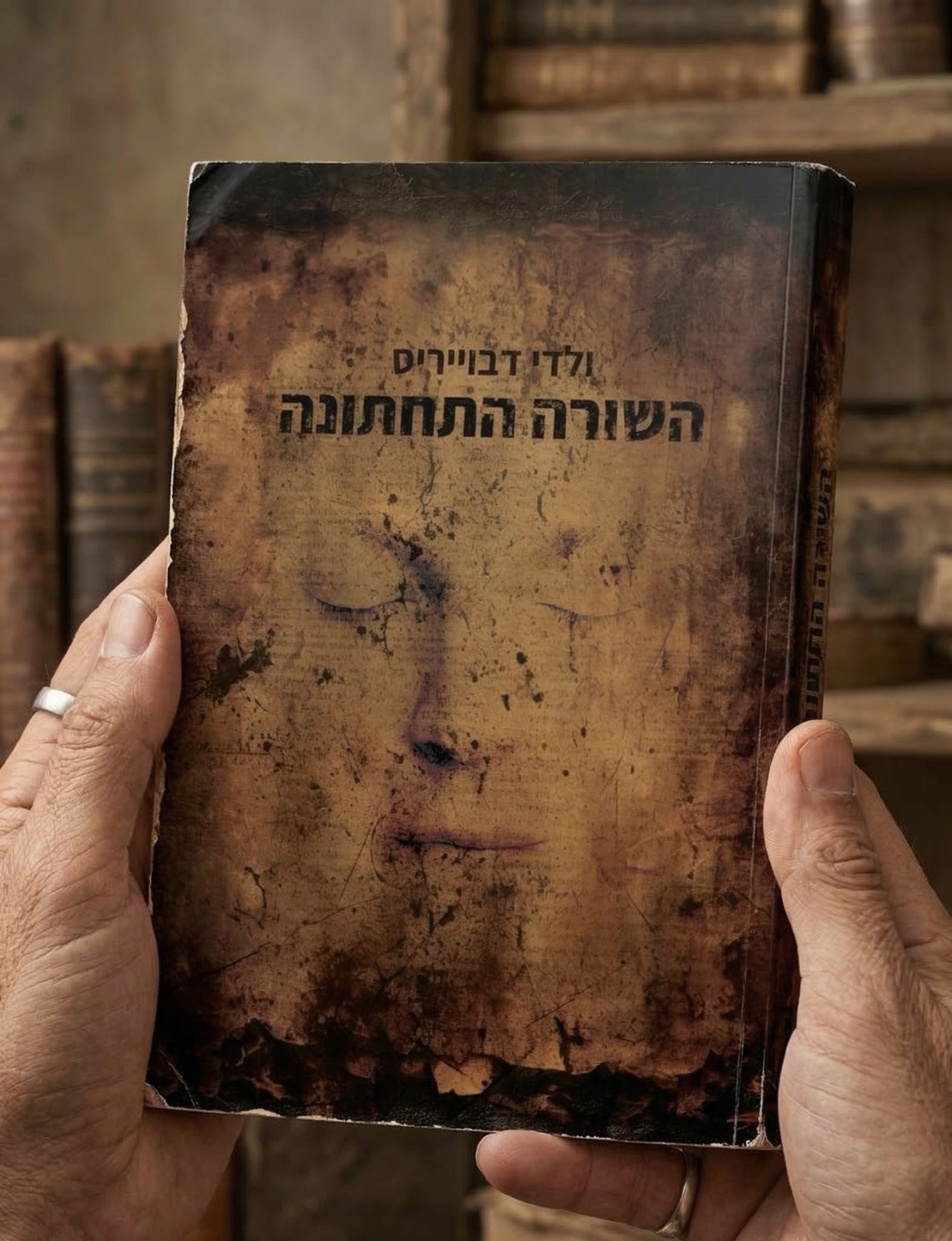
"The Bottom Line," a memoir of eleven weeks inside Israel's central casualty identification facility, publishes September 1 — following a Hebrew edition reviewed across Israel's national press
PETAH TIKVA, Israel — August 17, 2026 — At five o'clock in the morning on October 8, 2023, Dr. Vladi Dvoyris answered a phone call from a colleague. Trucks full of bodies were arriving at a base he had never heard of. Could he come and help identify them?
He said yes before he understood what he was agreeing to. He stayed eleven weeks.
Dvoyris, a dentist with fifteen years in practice and no prior training in forensic identification, spent those weeks at Camp Shura, the Israeli military's central casualty identification facility — a place he and his colleagues came to call the Death Star. Working with a dental mirror, X-ray film and DNA swabs, his task was to match names to the numbers written on body bags. In the first two days alone, the facility received roughly 300 soldiers and 900 civilians, in a building designed to hold 300.
"The Bottom Line," his memoir of that period, publishes in English on September 1, 2026, weeks before the third anniversary of the October 7 massacre.
It is not, its author insists, a book about horror.
"There is horror in it, and I haven't hidden it," Dvoyris said. "But most of what I remember from that place is people — their humor, their decency, and the strange fact that in a country tearing itself apart, we worked side by side without once asking who anyone had voted for."
The book began as a diary kept at the end of each day. "When I read it back afterward, my first thought was that anyone who read this would be traumatized by it," he said. Rather than publish the raw record, he rewrote it as literary narrative, giving the story to a lightly fictionalized narrator named Zeev Spektor — a distance, he says, intended as much for the reader's protection as for his own.
The memoir moves between two timelines: the mortuary itself, and the making of the man who could work there — a Soviet-Jewish childhood in Ukraine, immigration to Israel, dental school in Jerusalem during the Second Intifada, and four generations of physicians reaching back to a great-grandmother who treated teeth without anesthesia. It closes two years later at a military cemetery, where Dvoyris sought out the parents of the one soldier whose face he could not forget, and placed on the grave a stone he had gathered on a beach in Cyprus days before the attack.
Published in Hebrew in April 2026 after a crowdfunding campaign backed by 400 readers, the book sold 800 copies in its first two months and was reviewed in all three of Israel's major newspapers.
Haaretz critic Maya Becker wrote that it "differs from the many October 7th books not only in its meticulous, merciless clinical detail and its macabre humor, but because the writer leaves emotion outside the base," adding that its power lies "in the gap between the drama-less, almost cold and matter-of-fact reporting — and the closing chapters, where the post-trauma rises up in full force." Israel Hayom called it "a literary memoir, hovering between the documentary and the intimate." Israeli readers have rated it 4.8 out of 5.
Dvoyris translated and adapted the English edition himself; it was edited by American author Marc Tyler Nobleman.
The timing is deliberate. The third anniversary falls on Simchat Torah for those who mark the Hebrew date and on October 7 for those who mark the civil one — four days apart. "This is the season when communities ask how to remember something that is receding from the news but not from the people who carry it," Dvoyris said. "Several readers told me this was the first thing that let them approach October 7th at all. That is the only reason I published it."
"The Bottom Line" (approx. 43,000 words) will be available September 1 in Kindle, hardcover, and paperback editions on Amazon worldwide. Review copies are available on request.
Dr. Dvoyris lectures on the book in English, Hebrew and Russian, and is available for interviews and virtual events.
Dr. Vladi Dvoyris · vladi@dvoyris.com · +972-54-477-8556 · thebottomlinebook.net
High-resolution cover art, author photographs, and translated excerpts of the Israeli press coverage are available above — no request necessary.
Three years on, a first-person account from inside the room where the dead were identified. Two anniversary dates four days apart: Simchat Torah (Oct 3–4) and October 7.
What fifteen years in a dental chair secretly prepares you for. A clinician's memoir for medical and dental press.
Four generations of physicians, a Soviet-Jewish childhood in Ukraine, and the 1.5 generation's double identity.
A diary that took two years to become a book, and the fictionalized narrator the author created to make it survivable to write and to read.
Dr. Vladi Dvoyris (born Ukraine, 1983) immigrated to Israel with his family in the early 1990s. He studied dentistry in the Academic Reserve and served as a military dentist. Since his discharge, over the past decade, he has worked in software development for the dental and medical industries. He also served as a translator into Hebrew, Russian and English for various film and television productions in Israel and abroad. Following the October 7, 2023 massacre, he was mobilized as a reserve dentist in the military casualty identification unit. "The Bottom Line" is his first book.
Dr. Vladi Dvoyris (born Ukraine, 1983) immigrated to Israel with his family in the early 1990s. He studied dentistry in the Academic Reserve, in Jerusalem during the Second Intifada, and served as a military dentist. He is the last of four generations of physicians, a line reaching back to a great-grandmother who treated teeth without anesthesia. Since his discharge, over the past decade, he has worked in software development for the dental and medical industries. He has also served as a translator into Hebrew, Russian and English for film and television productions in Israel and abroad. At five in the morning on October 8, 2023, he answered a phone call asking whether he could help identify bodies at a base he had never heard of. He said yes before he understood what he was agreeing to, and stayed eleven weeks — working with a dental mirror, X-ray film and DNA swabs at Camp Shura, the Israeli military's central casualty identification facility, matching names to the numbers written on body bags. "The Bottom Line," his first book, began as a diary kept at the end of each day and was published in Hebrew in April 2026 after a crowdfunding campaign backed by 400 readers. It was reviewed in all three of Israel's major newspapers. He translated and adapted the English edition himself. He lectures on the book in English, Hebrew and Russian.
Israel's paper of record; reviewed in its literary section.
“Differs from the many October 7th books not only in its meticulous, merciless clinical detail and its macabre humor, but because the writer leaves emotion outside the base.”
“Its power lies in the gap between the drama-less, almost cold and matter-of-fact reporting — and the closing chapters, where the post-trauma rises up in full force.”
Israel's highest-circulation daily newspaper.
“A literary memoir, hovering between the documentary and the intimate.”
One of Israel's long-established national dailies.
“Between unimaginable reality and fine macabre humor unfolds a shattering human diary.”
Translated from the Hebrew.
Rated 4.8/5 by Hebrew readers across 18 reviews.
No form, no email required.
Cover art is supplied in RGB for web and CMYK 300dpi for print.
Dr. Dvoyris is available for interviews in English, Hebrew, and Russian. These questions are offered as a starting point — please use, adapt, or ignore them freely.
Available on Amazon from September 1, 2026.